
The Three Granthis: The Invisible Knots That Bind Us

Updated: 3 hours ago
An exploration of the subtle knots of attachment, identity and conditioning that bind consciousness and how Tantra invites us to recognise and gradually loosen them

The Strings We Cannot See
Once, while travelling through India, I came across a tree covered with strings. Some were red, some yellow, some already faded by the sun and rain. Hundreds of threads had been tied around its branches. Some carried small talismans; others were simply knotted. Each represented a prayer, a vow, a wish, a hope—something a person wanted to hold before the Divine until it was fulfilled.
I stood before that tree for some time, looking at all those knots, when a completely different question arose within me:
"Are we not also tied in exactly the same way?"
Perhaps there are no physical strings around our bodies, yet within us runs an invisible web of attachments.
A memory continues to pull us towards yesterday. A relationship becomes a place where we seek our completeness. A possession quietly becomes part of our identity. An old wound shapes the way we meet the present. Expectations bind us to an imagined future, while fears keep us circling around what may never happen.
"Desires pull us forward, memories pull us backwards, and beliefs quietly define the boundaries within which we live."
Eventually, these invisible connections become so familiar that we stop recognising them as bonds. We simply call them “my life,” “my nature,” “my story,” or even “myself.”
And perhaps this is the strangest kind of bondage:
"When the strings become invisible, we begin to mistake the knot for ourselves."
A physical knot can be seen and untied. But how do you untie a belief you have carried for thirty years? How do you loosen an identity inherited from childhood? How do you release a fear that has become part of your personality? How do you free yourself from another person's approval when you do not even realise you are seeking it?
These are not physical strings. They are subtle knots woven from memory, emotion, desire, fear, conditioning and identification. In the ancient language of Yoga, these inner knots are called Granthis
What Is a Granthi?
The Sanskrit word Granthi (ग्रन्थि) means a knot, tie, binding, joint, or something tightly intertwined. It is an extraordinarily precise image for the human condition.
Imagine a long thread lying freely. Twist one part of it repeatedly around itself, and a knot appears. Nothing foreign has entered the thread.
The knot is made of the thread itself.
Yet once knotted, the thread loses its freedom of movement. The same metaphor can be applied to consciousness.
Consciousness itself is not the knot; the knot appears when consciousness contracts around identification.
“I am this body.”
“This belongs to me.”
"I cannot live without this person.”
“I need to be recognised.”
“I am my pain.”
“I am my achievements.”
“I know.”
“I am spiritually advanced.”
Each identification adds another turn to the knot. Eventually, we forget the free thread beneath it and begin calling the knot “me.”
This is why Tantra does not merely ask, “What are you attached to?” It asks something deeper:
“Where has your consciousness become knotted?”
Where Did the Idea of the Granthis Come From?

The idea of the Granthi predates the later systematic development of Tantra and belongs to the wider spiritual vocabulary of India.
The Upaniṣadic tradition already uses the image of the knot to describe profound human bondage. The Muṇḍaka Upaniṣad famously speaks of the “knots of the heart” being cut when the Highest Reality is directly known, while the Kaṭha Upaniṣad similarly speaks of the knots dwelling in the heart being released.
The original image, therefore, is far deeper than the modern idea of a simple “chakra blockage.” Granthi points towards the binding created by ignorance, desire, identification and the mistaken experience of separateness.
As the subtle-body teachings of Yoga and Tantra developed, this ancient metaphor became increasingly connected with prāṇa, nāḍīs, chakras and Kuṇḍalinī Śakti.
Yogic traditions came to speak particularly of three great knots:
1) Brahma Granthi,
2) Viṣṇu Granthi and
3) Rudra Granthi.
Their exact subtle-body locations and interpretations are not completely uniform across every lineage, so it is wiser not to imagine them as three physical lumps hidden somewhere inside the spine.
They are better understood as psycho-energetic thresholds—places where consciousness, energy and identity have become deeply intertwined.
But their names raise an important question.
Understanding the Three Granthis: Brahma, Viṣṇu and Rudra

Are Brahmā, Viṣṇu and Rudra not names associated with the great divine functions of the Hindu Trinity? Why would their names be given to knots?To understand this, we must look beyond the deities merely as divine personalities. In the symbolic language of Indian spirituality,
Brahmā, Viṣṇu and Rudra also represent three universal movements of existence: creation, preservation and dissolution. Brahmā creates. Viṣṇu sustains. Rudra dissolves and transforms.
Look carefully and these three movements are happening everywhere. A thought arises, remains for a while and disappears. A relationship begins, is sustained and eventually changes. A body is born, lives and dies. A desire appears, is nourished and eventually fulfilled, transformed or abandoned.
Brahmā (Creation)
Visnu (Preservation)
Rudra (Dissolution
Tantra takes these cosmic principles and turns them inward. The same movements operating throughout the universe are operating within our psyche. Something is created. We identify with it. Then we try to preserve it. Finally, when life demands transformation, we resist its dissolution. The divine functions themselves are not knots. The Granthi appears when consciousness becomes entangled with what these functions create, sustain or dissolve.
This gives us a simple way of entering the mystery of the three Granthis:
Brahma Granthi is the knot of becoming and embodiment.
Viṣṇu Granthi is the knot of preserving and attachment.
Rudra Granthi is the knot of identity that resists its own dissolution.
Brahmā asks: What have I become identified with? Viṣṇu asks: What am I desperately trying to preserve? Rudra asks: Who is the “I” that still refuses to disappear?
Brahma Granthi — The Knot of Becoming

Brahma Granthi reflects our deep identification with manifested existence: the body, survival, security, possession, sensual experience, pleasure and material identity. Its most fundamental voice is: “I am this body.” From this arise many other movements: “I need security.” “This is mine.” “I cannot lose this.” “Without this possession, pleasure, status or physical identity, I will become less.”
But Tantra does not say that the body is sinful or matter is spiritually inferior; quite the opposite. Tantra sees the body and the material universe as manifestations of Śakti. Matter is not the bondage; identification with matter is the knot. For instance:
Money is not Brahma Granthi, but believing that without money you are nothing may reveal the knot.
The body is not Brahma Granthi, but believing that your entire being begins and ends with the body may reveal it.
Pleasure is not the knot; the knot becomes visible when you cannot remain inwardly free when pleasure disappears.
Brahmā represents creation, and creation is sacred. The knot forms when consciousness becomes imprisoned within what has been created and forgets its greater nature.
So Brahma Granthi quietly asks:
“What in the created world have I mistaken for myself?”
Can I enjoy something without needing to own it? Can I possess something without allowing it to possess me? Can I experience pleasure without becoming its servant?
When these questions can be lived rather than merely answered, the knot of becoming begins to loosen.
Viṣṇu Granthi — The Knot of Preserving
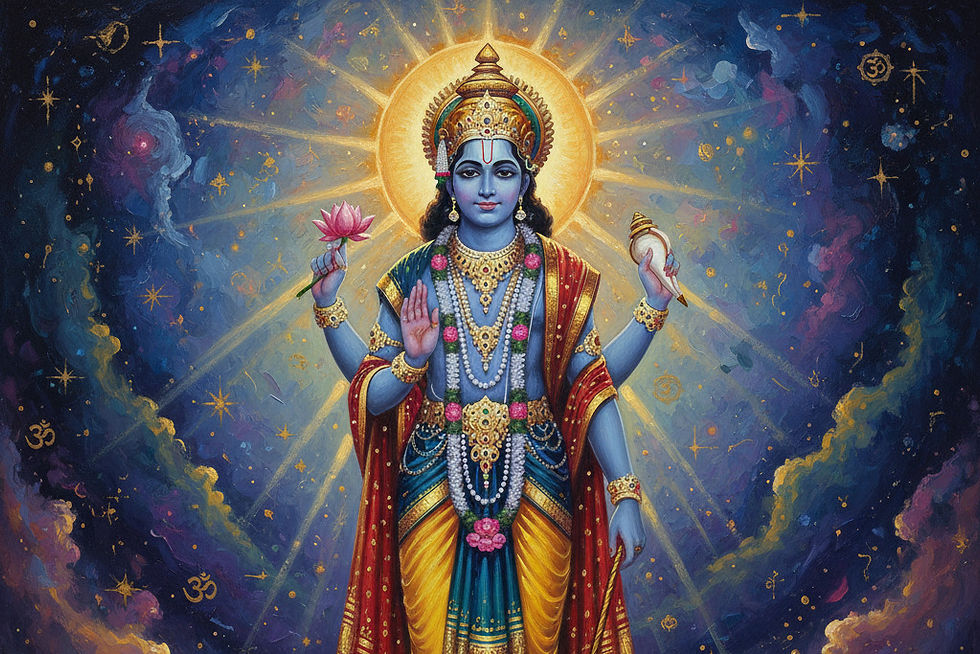
Once something has entered our lives, another movement begins: we want it to remain. This brings us to Viṣṇu Granthi. Viṣṇu represents preservation, continuity, nourishment and the sustaining of what has been created. Psychologically, however, preservation can become attachment when our inner stability depends upon keeping something unchanged.
A relationship begins—let it remain.
Someone loves us—let that love remain.
We gain status—let it remain.
People respect us—let their opinion remain.
Slowly, preservation becomes possession. The problem is not sustaining
what we love; the knot appears when we cannot allow what we love to change.
Its hidden voice says:
“Without you, I am incomplete.”
This knot can be difficult to recognise because attachment often disguises itself as love, e.g.
“I control you because I care.”
“I worry because I love you.”
“I need you to remain this way because we belong together.”
Tantra asks us to look more carefully. Love and attachment may exist together, but they are not the same.
Love | Attachment |
Love opens | Attachment contracts |
Love allows another person to breathe | Attachment fears their freedom |
Love says, “May you become what you truly are.” | Attachment whispers, “Please remain what I need you to be.” |
This is why external renunciation alone does not guarantee freedom:
You can leave a house and still carry the house inside your head.
You can leave a relationship and remain psychologically married to its memory for twenty years.
You can stop speaking to someone and continue arguing with them every night inside your mind.
Sound familiar? The physical string has disappeared, but the invisible string remains.
Viṣṇu Granthi therefore asks:
“What am I desperately trying to keep unchanged?”
The knot begins to loosen when love remains, but possession weakens; when relationship remains, but psychological imprisonment disappears; and when we can care deeply without making another human being responsible for our inner completeness.
Rudra Granthi — The Knot of the Final Identity

Then comes perhaps the most sophisticated knot: Rudra Granthi. Rudra represents dissolution, transformation and the fierce breaking open of forms that have completed their purpose. But by this stage of the inner journey, what remains to be dissolved may no longer be obviously material or emotional. The final attachment may be to the one who believes itself to be spiritual.
“I know.”
“I understand.”
“I am a yogi.”
“I am awakened.”
“I have experienced Kuṇḍalinī.”
“I have seen visions.”
“I am a teacher.”
“I am different.”
The ego is remarkably intelligent. If it cannot become special through possessions, it can become special through renunciation. If it cannot become important through wealth, it can become important through spirituality. It can remove the crown of the king; and quietly put on the crown of the enlightened one.
Suppose you enter meditation one evening and experience extraordinary silence. For several minutes the ordinary sense of self disappears, and there is immense bliss. The next morning you sit again, and the mind immediately says: “I want yesterday's experience back.”
Yesterday the experience opened a door.
Today the memory of that experience has become another possession.
Yesterday it liberated you;
Today you are holding it.
This is the subtle territory of Rudra Granthi. Rudra does not merely dissolve what we dislike. Rudra dissolves what has completed its purpose—even identities we consider sacred. Eventually the meditator must examine the identity of “meditator,” the seeker must examine the identity of “seeker,” and the knower must examine the identity of “the one who knows.”
The question is no longer,
“What did I experience?”
It becomes:
“Who is claiming the experience?”
And here the mystery deepens, because the one trying to untie the knot discovers that it too may be woven into the knot.
The Granthis and Kuṇḍalinī

This is why the Granthis became significant in traditions dealing with Kuṇḍalinī Śakti. Kuṇḍalinī is often popularly imagined as a mysterious energy shooting upwards through the spine. But the Tantric version can be understood more deeply as a transformation of consciousness from contraction towards expansion, from identification towards recognition.
As Śakti moves, consciousness encounters what it has been holding:
At Brahma Granthi, we encounter our identification with embodiment, survival, security and possession.
At Viṣṇu Granthi, we encounter emotional dependency, relationship, belonging and the need for validation.
At Rudra Granthi, we encounter attachment to perception, knowledge, spiritual experience and finally to the individual knower itself.
This is why dramatic energetic experiences should never automatically be mistaken for liberation, e.g.
A person may experience powerful energy and remain deeply jealous.
Someone may have visions and still desperately seek recognition.
One may speak beautifully about non-duality while being unable to tolerate criticism.
Energy moving is not necessarily a knot dissolving. The more useful question is:
Has identification weakened?
Are you becoming freer?
Less reactive?
Less possessive?
Less frightened of losing?
Less dependent upon recognition?
More capable of loving without controlling?
More comfortable with not knowing?
If these deeper transformations are absent, perhaps an experience has occurred, but the Granthi may still be intact.
How Tantra Approaches the Knots

Tantra does not begin by declaring war on these knots. When we discover attachment, jealousy, desire or ego, our first reaction may be: “I must destroy this.” But Tantra recognises something subtle: the person desperately trying to destroy attachment can itself become another attachment, e.g:
If I hate my desire, I remain connected to desire through hatred.
If I obsessively fight my ego, I remain occupied with ego.
If I desperately crave enlightenment, enlightenment itself becomes another desire.
So Tantra does not necessarily begin by cutting the thread. Tantra begins by seeing the knot. For instance:
Where does it tighten?
What triggers it?
What emotion feeds it?
What belief hides inside it?
How does your breathing change when you touch the knot?
Where does the body contract?
What identity are you protecting?
The movement is from:
unconscious bondage -> conscious observation,
from
observation -> understanding,
from
understanding -> transformation,
and from
transformation -> release.
This is why Tantra works through the whole human organism:
Through embodied awareness and āsana, we notice physical contraction.
Through prāṇāyāma, we discover how emotion and thought are reflected in breath and prāṇa.
Through mantra, sacred sound interrupts habitual mental patterns.
Through mudrā and bandha, certain traditions work with the organisation and direction of prāṇa.
Through dhyāna, thought is witnessed without immediately becoming identity.
Through deeper inquiry, awareness eventually turns toward the one who is experiencing everything.
But techniques themselves are not the destination. Every genuine practice should eventually reveal where you are holding.
Watch your breath when someone insults you.
Watch your chest when someone you love withdraws affection.
Watch your stomach when financial insecurity appears.
Watch your throat when you desperately want to defend yourself.
Watch the mind when someone else receives the recognition you wanted.
Watch the subtle pleasure when someone calls you spiritually advanced.
There. That tightening is your scripture.
Life reveals the Granthis every day.
The Body Often Knows Before the Mind

The intellectual mind can lie beautifully:
“I am not jealous.”
“I am detached.”
“I have forgiven.” “I don't care what people think.” Yet the body may tell another story. The jaw tightens. The breath becomes shallow. The stomach contracts. The heartbeat changes. The shoulders become rigid. The mind begins rehearsing imaginary conversations.
The body often reveals the knot before philosophy can hide it.
So when a powerful reaction arises, instead of immediately asking, “How can I get rid of this?” ask: “Where am I holding?”
Become quiet.
Feel the body.
Feel the breath.
Feel the emotion before naming it.
Do not justify it and do not condemn it.
Enter the knot with awareness.
A knot survives partly because it remains unconscious. Awareness brings it into the light.
Returning to the Tree

I often return in my mind to that tree in India—hundreds of strings, hundreds of knots, hundreds of wishes. Perhaps every human being is such a tree. Some invisible strings gather around our body, security and possessions:
Brahma Granthi:
Some gather around our heart, relationships and need to preserve what we love.
Viṣṇu Granthi:
And some gather around our identity, knowledge and sense of “I”
Rudra Granthi:
The first whispers: “I am what I have.”
The second whispers: “I am who loves me and what I can keep.”
The third whispers: “I am what I know and what I have spiritually become.”
Tantra keeps asking us to look beneath all three.
If I am not merely what I possess, who am I?
If I am not merely the body, who am I?
If I am not merely my relationships, memories and emotions, who am I?
If I am not even my spiritual experiences, who am I?
And finally: If every definition I have created about myself becomes silent, what remains?
Do not answer too quickly. The mind may immediately say, “I am Brahman,” “I am Śiva,” or “I am pure consciousness.” These may be profound teachings, but if they remain merely conceptual, the mind may have tied a new spiritual string around an ancient knot.
Tantra asks us not merely to repeat the answer, but to enter the experience from which the answer arises.
The Knot Was Never Separate From the Thread

Look closely at an ordinary knot and something mysterious becomes obvious:
There is actually no separate object called a knot.
There is only thread arranged in a particular way.
Untie it and ask: where did the knot go? Nowhere.
Nothing had to be destroyed. Nothing foreign had to be removed.
The thread simply stopped being contracted around itself.
Perhaps this is the deepest beauty of the Granthi metaphor.
The knot is consciousness contracted around identity.
When the contraction releases, consciousness does not become something new. It simply ceases to be trapped within a limited definition of itself.
This is why Tantra is not fundamentally a war against the body, sexuality, emotion, relationship, thought or the world.
The world is not the knot.
The body is not the knot.
Love is not the knot.
Possession itself is not the knot.
Even spiritual experience is not the knot.
The knot is the unconscious insistence:
“Without this, I cannot be complete.”
Tantra enters that sentence and quietly asks:
“Are you sure?”
Then slowly, patiently, and sometimes painfully, one invisible string after another begins to loosen.
The body remains, but identification softens.
Relationships remain, but possession softens.
Knowledge remains, but arrogance softens.
Life remains, but the desperate need to control life softens.
And perhaps one day we discover that freedom was never waiting somewhere above the final chakra.
Freedom was the thread beneath the knot all along.
Brahma Granthi loosens.
Viṣṇu Granthi loosens.
Rudra Granthi loosens.
Śakti flows.
The seeker becomes quiet.
And what remains is not another identity to wear around the neck like a sacred talisman.
What remains is the simple, unknotted presence of Being.
Perhaps that is Tantra's invitation:
Do not cut yourself away from life. Untie what prevents you from being completely alive. - Prem Chaitanya
At Soul Search, we recognise that the knots we carry reveal themselves differently for every seeker. Some appear through attachment and relationships, others through fear, identity, desire or the need for recognition. Becoming aware of these patterns is often the first step towards understanding what we are still holding.
Through the Path of Sound, Path of Light, and Path of Knowledge, we offer different ways to explore these inner patterns through sacred sound, meditation, self-inquiry and deeper understanding. Rather than escaping from life, these practices invite us to meet it with greater awareness and gradually recognise where consciousness has become bound.
For perhaps the journey is not about becoming someone new, but gently loosening the knots that prevent us from recognising what has always been there.


Comments